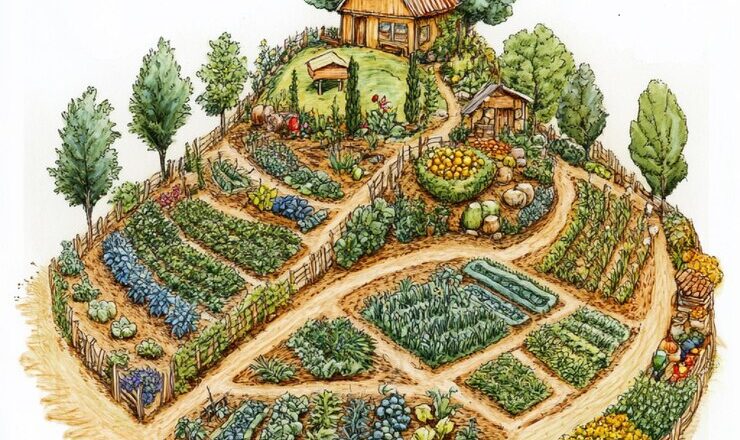
Permaculture Practices


- Description
- Curriculum
- FAQ
- Notice
- Reviews
- Grade
The course covers essential topics such as zoning, companion planting, natural building, and integrated pest management. Through interactive design exercises, participants will develop practical skills in planning permaculture systems for various environments, including urban, suburban, and rural settings. The course also delves into ethical principles, including care for the earth, care for people, and fair resource distribution. By the end of the course, participants will be equipped to apply permaculture practices to their own gardens, farms, or community projects, creating resilient systems that support both human needs and the environment.
I.Course Objectives:
-
Knowledge Acquisition: Participants will gain a comprehensive understanding of permaculture principles, farming specific issues, and common practices.
-
Critical Thinking: Students will develop the ability to analyze environmental problems related to farming, evaluate solutions, and make informed decisions.
-
Environmental Awareness: The course will cultivate a sense of responsibility and commitment to protecting the planet.
-
Sustainable Behavior: Participants will be encouraged to adopt sustainable practices in their daily lives.
-
Active Citizenship: Students will learn how to engage in environmental activism and contribute to positive change.
II. Learning Outcomes:
Futures Literacy: Through exploring the causes and effects of environmental issues, the course will enable students to envision alternative sustainable futures. They will learn design with nature and identify the steps required to achieve a preferred sustainable future with permaculture principles.
Exploratory Thinking: Through examining various environmental topics and considering solutions, students will develop exploratory thinking skills. They will learn to link different disciplines, applying creativity and experimentation to develop novel ideas and methods for sustainability.
Collaborating Through Digital Technologies: Depending on the course’s design, students may engage in collaborative activities using digital tools. This could involve co-creation of projects or shared learning experiences.
Protecting Health and Well-being: Students will become aware of potential health risks associated with digital technology use and learn strategies for maintaining well-being in online environments. This includes addressing issues like cyberbullying and promoting positive online interactions.
Protecting the Environment: The course content will raise awareness about the environmental impact of digital technologies. This aligns with the course’s overarching theme of environmental responsibility.
Empathy: By exploring the impact of environmental issues on different communities and ecosystems, students will develop their empathy and understanding of diverse perspectives
Coping with Uncertainty, Ambiguity & Risk: Exploring complex environmental issues and their potential solutions will encourage adaptability and the capacity to make decisions amidst uncertainty.
Critical Thinking: By analyzing information about environmental challenges, evaluating different perspectives, and forming their own conclusions, students will hone their critical thinking skills.
when a user login for the first time
The Green Skills Beginner Badge is for anyone taking their first step into sustainability. It’s easy to earn and helps you get started on your learning journey! ✔ Start the Course – Simply enroll and begin. 🌱 Enrolling in the Course – +50 points Reaching 100 points unlocks the Green Skills Beginner Badge, celebrating your first step toward sustainability! 🎉♻
The Expert Badge is awarded to learners who demonstrate exceptional knowledge and engagement in an online course. This prestigious recognition highlights a deep understanding of course material and active participation in learning activities. ✔ Completion of All Course Modules – Successfully finish all lessons, quizzes, and assignments. Learners earn points through various activities:
The Informed Badge is awarded to learners who have gained a solid understanding of green skills and sustainability concepts. This badge shows that you’ve moved beyond the basics and are actively learning. ✔ Complete One Course – Finish at least one course. 🌿 Course Completion – 200 points (100 points per course). Reaching 200 points unlocks the Informed Badge, showing your growing knowledge in sustainability! 🌍♻ The Leader Badge is awarded to learners who complete the full course and demonstrate a strong understanding of green skills. ✔ Complete the Full 5 Courses – Finish 5 courses. 🏆 5 Courses Completion – +400 points Reaching 400 points unlocks the Leader Badge, recognizing your commitment to sustainability! 🌱🌍 The Green Skills Starter Badge is awarded to learners who take their first steps toward understanding sustainability and eco-friendly practices. This badge recognizes basic knowledge and initial engagement in green skills education. ✔ Complete the First Section – Finish the introductory lesson on green skills. 🌱 First Section Completed – +50 points
1st login
1 Step
Green Skills Beginner & Achievement Points
Criteria for Earning the Badge:
✔ Complete one lesson – Complete any lesson.
✔ Complete One Quiz – No minimum score required!Achievement Points System:
🌱 Trying a Quiz – +20 points4 Steps

Expert badge
Criteria for Earning the Expert Badge:
✔ High Quiz Performance – Achieve an average score of 80% or higher on all assessments.Achievement Points System:
🎯 Course Completion – +100 points/course
🎯 Quiz Passed (80% or above) – +20 extra points14 Steps

Informed Badge & Achievement Points
Criteria for Earning the Informed Badge (200 Points):
Achievement Points System:
1 Step

Leader Badge & Achievement Points
Criteria for Earning the Leader Badge (400 Points):
✔ Pass All Quizzes – Score at least 70% overall.Achievement Points System:
9 Steps

Green Skills Starter Badge & Achievement Points
Criteria for Earning the Green Skills Beginner Badge:
✔ Pass One Quiz – Score at least 50% on any quiz.
✔ Complete any interactive content – View at least one interaction educational element in the course.Achievement Points System:
🌱 Quiz Attempted – +20 points
🌱 Interactive content – +10 points3 Steps
-
1
 Key Ethics & Permaculture Design Principles
Welcome to the world of permaculture! Imagine designing a garden or farm that not only produces food but also restores the natural environment, conserves water, builds soil, and even enriches community ties. This approach, known as permaculture, goes beyond traditional farming. It’s a sustainable design philosophy that embraces nature’s wisdom to create resilient, regenerative ecosystems.
In this lesson, we’ll explore the key ethics and foundational principles that make permaculture a unique and powerful approach to sustainable living. Whether you’re interested in transforming your backyard, creating a community garden, or making your farm more eco-friendly, these concepts will help guide you toward a more sustainable and abundant future.
-
2
 Key Ethics & Permaculture Principles QUIZ!
 -
3
Observe and Interact
This section covers the core principles and ethics of permaculture, including observe and interact, catch and store energy, obtain a yield,, apply self regulation and feedback, use and value renewables. The course also emphasizes permaculture ethics, earth care, people care, and fair resource distribution.
-
4
Observe and Interact QUIZ!
-
5
Catch and Store Energy
The permaculture principle of "Catch and Store Energy" is all about harnessing natural resources when they're abundant and using them when needed. This principle encourages us to think strategically about capturing energy, from sunlight to rainwater, and storing it in ways that support sustainable living and farming. In this lesson, you’ll explore practical ways to "bank" energy for times when it’s less available.
-
6
Catch and Store Energy QUIZ!
-
7
Obtain a Yield
In permaculture, the principle of "Obtain a Yield" teaches us the importance of getting tangible returns from our efforts in nature. This isn’t just about farming or gardening—it’s a mindset that applies to everything we do. Obtaining a yield encourages us to design systems that are both productive and sustainable, ensuring that our energy and resources don’t go to waste. In this lesson, you’ll learn why obtaining a yield is essential and how it supports the overall health of any permaculture system.
-
8
Obtain a Yield QUIZ!
-
9
Apply Self-Regulation and Feedback
In permaculture, nature teaches us valuable lessons on sustainability, balance, and resilience. The principle of "Apply Self-Regulation and Feedback" encourages us to observe, adapt, and refine our actions based on the responses we receive from our environment. Just like plants adjust to sunlight and water availability, we too can learn to fine-tune our actions and practices, avoiding overuse of resources and minimizing negative impacts on our surroundings.
-
10
Apply Self-Regulation and Feedback QUIZ!
-
11
Use and Value Renewables
This lesson introduces the principle of “Use and Value Renewables” in permaculture, which focuses on harnessing renewable resources and recognizing their immense value in creating sustainable systems. In this lesson, you’ll explore why renewables are crucial, the benefits they offer, and practical examples of using renewable resources in a permaculture setup.
-
12
Use and Value Renewables QUIZ!
-
13
Produce No Waste
The principle of "Produce No Waste" in permaculture is all about closing the loop on waste by viewing it as a valuable resource. In nature, waste doesn’t really exist; everything has a purpose and can contribute to the ecosystem. In this lesson, we’ll explore practical ways to apply this concept to our lives, transforming waste into useful resources that benefit both the environment and ourselves.
-
14
Flashcards
Flashcard to help you test your knowledge.
-
15
Design from Patterns to Details
This principle encourages us to observe the natural world and identify patterns that reveal how ecosystems function harmoniously. From broad weather patterns to the way plants grow together, nature is full of repeating forms and relationships. By recognizing and working with these patterns, we can create resilient, productive, and sustainable systems in our gardens, farms, or even urban spaces.
-
16
Fill in the blank
-
17
Integrate Rather Than Segregate
In this lesson, we’ll explore the concept of “Integrate Rather Than Segregate,” a core principle in permaculture that emphasizes the benefits of collaboration, cooperation, and mutual support within ecosystems. By integrating elements and fostering relationships rather than isolating components, we create resilient and sustainable systems where every part strengthens the whole.
-
18
Find the words!
Find the words!
-
19
Use Small and Slow Solutions
In a world that often celebrates speed and instant results, the principle of "Use Small and Slow Solutions" invites us to take a step back and appreciate the beauty of gradual change. Just as a tiny seed grows into a mighty tree, small, thoughtful actions can lead to significant, sustainable transformations in our lives and the environment. This lesson dives into the importance of this principle in permaculture and how it can be applied to create resilient ecosystems, thriving communities, and a healthier planet.
-
20
Drag the words!
Something to take away from the previous course!
-
21
Use and Value Diversity
Just as a varied diet keeps us healthy, a diverse ecosystem is critical for the health and resilience of our environment. In this lesson, we’ll explore how to use and value diversity as a core principle of permaculture, understanding how it enhances productivity, promotes resilience, and supports a sustainable future.
-
22
Fill in the blanks!
-
23
Use Edges and Value the Marginal
In the world of permaculture, edges are where the magic happens. They are the transitional zones between different ecosystems—where forests meet fields, water meets land, or even urban areas blend with nature. These marginal spaces are often overlooked, yet they hold incredible potential for biodiversity, productivity, and sustainability.
In this lesson, we will explore how to recognize the value of edges and marginal areas in our designs, discovering how they can enhance our permaculture practices and contribute to a more resilient environment.
-
24
Another interactive exercise!
Crosswords!
-
25
Creatively Use and Respond to Change
Change is not just an inevitable part of life; it’s the very essence of permaculture. In nature, everything is in constant flux, and thriving ecosystems are those that adapt to shifts in their environment. From the changing seasons to varying rainfall patterns, the ability to respond to change with creativity and resilience is crucial for sustainable living. In this lesson, we’ll explore how you can harness the power of change in your permaculture practices, transforming challenges into opportunities for innovation and growth.
-
26
Permaculture principles
-
27
Survey
Please complete this short survey.
Productivity Hacks to Get More Done in 2018
— 28 February 2017
- Facebook News Feed Eradicator (free chrome extension) Stay focused by removing your Facebook newsfeed and replacing it with an inspirational quote. Disable the tool anytime you want to see what friends are up to!
- Hide My Inbox (free chrome extension for Gmail) Stay focused by hiding your inbox. Click "show your inbox" at a scheduled time and batch processs everything one go.
- Habitica (free mobile + web app) Gamify your to do list. Treat your life like a game and earn gold goins for getting stuff done!